Browse the glossary using this index
Special |
A |
B |
C |
D |
E |
F |
G |
H |
I |
J |
K |
L |
M |
N |
O |
P |
Q |
R |
S |
T |
U |
V |
W |
X |
Y |
Z |
ALL
AISSEE (Grade6)
| Subject |
No of Ques |
Each Correct Ans |
Total Marks |
| Lanuage |
25 |
2 marks |
50 |
| Mathematics |
50 |
3 marks |
150 |
| Intelligence |
25 |
2 marks |
50 |
| General Knowledge |
25 |
2 marks |
50 |
| Total |
125 |
|
300 |
Sainik School Syllabus for Class 6 Maths
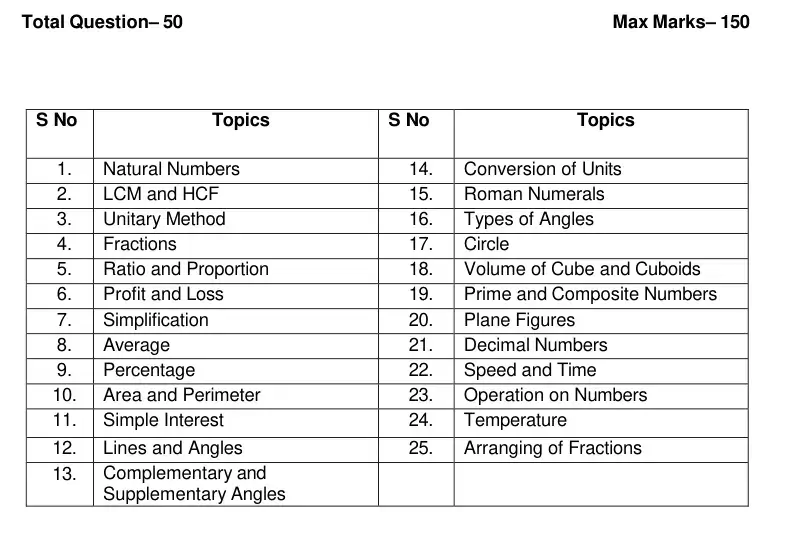
Sainik School Syllabus Class 6 Maths
- Total number of questions: 50
- Each question: 3 marks
- Total mark: 150
- Mathematics carries the highest weightage (50%) of marks among the 4 subjects.
| SL |
Topic |
| 1 |
Natural Numbers |
| 2 |
LCM and HCF |
| 3 |
Unitary Method |
| 4 |
Fractions |
| 5 |
Ratio and Proportion |
| 6 |
Profit and Loss |
| 7 |
Simplification |
| 8 |
Average |
| 9 |
Percentage |
| 10 |
Area and Perimeter |
| 11 |
Simple Interest |
| 12 |
Lines and Angles |
| 13 |
Complementary and Supplementary Angles |
| 14 |
Conversion of Units |
| 15 |
Roman Numerals |
| 16 |
Types of Angles |
| 17 |
Circle |
| 18 |
Volume of Cube and Cuboids |
| 19 |
Prime and Composite Numbers |
| 20 |
Plane Figures |
| 21 |
Decimal Numbers |
| 22 |
Speed and Time |
| 23 |
Operation on Numbers |
| 24 |
Temperature |
| 25 |
Arranging of Fractions |
Sainik School Syllabus for Maths Class 6
|
|
Coding ( Grade 4) | Chapter | Topics | | 1. Introduction to Coding/Programming Languages | Digital E book Reference E book
|
| 1.1 | Definition | | 1.2 | Evolution | | 1.3 | Applications of Coding language | | 2. HTML | | | 2.1 | What is HTML | | 2.2 | Where is HTML used | | 2.3 | History of HTML | | 2.4 | Creating a HTML DOC | | 2.5 | Tags Elements and attributes | | 2.6 | Rules of writing HTML code | | 2.7 | HTML5 Document structure | | 2.8 | Write a HTML site | 3.Desigining and formatting a web page | | | 3.1 | Common HTML container elements | | 3.2 | Font style tags | | 3.3 | Attributes of body element | | 3.4 | empty elements | 4.Introduction to scratch programming | | | 4.1 | Starting scratch | | 4.2 | Main components of scratch | | 4.3 | Creating a new sprite using paint editor | | 4.4 | Saving sprite | | 4.5 | Moving a sprite | | 4.6 | Drawin colorful circle | | 4.7 | Making a duplicate copy of sprite | | 4.8 | Saving a scratch project | | 4.9 | Opening a saved project | | 4.10 | Variables in scratch |
|
|
Coding Grade (5) | Chapter | Topics | | 1. Introduction to Coding/Programming Languages | Digital E book Reference E book
|
| 1.1 | Definition | | 1.2 | Evolution | | 1.3 | Applications of Coding language | | 2. HTML | | | 2.1 | What is HTML | | 2.2 | Where is HTML used | | 2.3 | History of HTML | | 2.4 | Creating a HTML DOC | | 2.5 | Tags Elements and attributes | | 2.6 | Rules of writing HTML code | | 2.7 | HTML5 Document structure | | 2.8 | Write a HTML site | 3.Desigining and formatting a web page | | | 3.1 | Common HTML container elements | | 3.2 | Font style tags | | 3.3 | Attributes of body element | | 3.4 | empty elements | 4.Introduction to scratch programming | | | 4.1 | Starting scratch | | 4.2 | Main components of scratch | | 4.3 | Creating a new sprite using paint editor | | 4.4 | Saving sprite | | 4.5 | Moving a sprite | | 4.6 | Drawin colorful circle | | 4.7 | Making a duplicate copy of sprite | | 4.8 | Saving a scratch project | | 4.9 | Opening a saved project | | 4.10 | Variables in scratch | | 5. CSS | | | 6. XML | |
|
|
Coding Grade (6)
1 Introduction to Coding – (Programming Language ) | Digital E book Refrence E book | | 1.1 | How do traffic lights work (Only theory / what Coding language was used when introduced) | | 1.2 | Where else do we see applications of Coding? (Coding Language) | | 1.3 | What is an OS? Why do we need an OS? Types of OS ? | | 1.4 | What is Coding ? Evolution of Coding ? | | 1.5 | What is High, Mid & Low level Coding language? | | 2 Basic of C Program | | | 2.1 | Why C Programming ? Where does C stand? | | 2.2 | Define Keyword in programming language? | | 2.3 | Define identifiers in programming language? | | 2.4 | Define Variables? What is the variable declaration (Single / Multiple declaration? | | 2.5 | Types of Variables? | | 2.6 | What are data type in C | | 2.7 | Compilation of C Program – Hello world programs. | | 3 Algorithms, Operators & controls | | | 3.1 | What is the flowchart?Ex | | 3.2 | Programming operations on variables / Operators and its types? | | 3.3 | Example program, explain with flowchart / Pseudocode? | | 3.4 | Operators, I/O Operators in (Programming & basic terms | | 3.5 | Scanf .# include .int main  .%d,%i,%c,%f .%d,%i,%c,%f | | 3.6 | Print .<Studio>.{ } . ; | | 4 Flow controls in C programming | | | 4.1 | If Else | | 4.2 | While Loop | | 4.3 | Switch case | | 4.4 | For loop | | 4.5 | Break continue | | 4.6 | examples | | 5 Use block code | | | 5.1 | Practice Application on Arcade |
|
|
Coding Grade (7) | Chapter | Topics |
1 C Programming
| Digital E book Refrence E book
| | 1.1 | What is C Programming / Objectives of C Programming? | | 1.2 | Concept- Identifier keyword & variables, constant & data types | | 1.3 | Operators in C Programming & flow of control | | 1.4 | Loops & Nested loops | | 1.5 | Different level of Programming & its types | | 1.6 | Common Terms in C | | 1.7 | Function & Arrays + Pointers & Strings. | | 1.8 | Evolution of Programming language, its application | | 1.9 | Application building | | | | 2.1 | Concept of C++ | | 2.2 | Variables & literals, datatypes,basic I/O | | 2.3 | Type conversions | | 2.4 | Operators | | 2.5 | Comments | | 2.6 | C++ Flow controls, Arrays & String | | 2.7 | C++ oops- Object Oriented Programming | | 2.8 | C++ Inheritance | | 2.9 | Application building using C++ | | 2.10 | Application of Programming language | | 3 C++ Programming | | | 3.1 | Introduction to C++ variables & Literals | | 3.2 | About C++ | | 3.3 | Why C++ | | 3.4 | Data types | | 3.5 | Basic I / O | | 3.6 | Type conversion | | 3.7 | Operators | | 3.8 | Comments | | 3.9 | C++ OOPs – Object Oriented Programming | | 3.10 | C++ Inheritance | | 3.11 | Application building using C++ | | 3.12 | Hello world | | 3.13 | Calculator | | 3.14 | Print | | 3.15 | Using loops | | 3.16 | Age eligibility | | 3.17 | Login Form. |
|
|
Coding Grade (8) | Chapter | Topics |
1 C Programming
| Digital E book Refrence E book
| | 1.1 | What is C Programming / Objectives of C Programming? | | 1.2 | Concept- Identifier keyword & variables, constant & data types | | 1.3 | Operators in C Programming & flow of control | | 1.4 | Loops & Nested loops | | 1.5 | Different level of Programming & its types | | 1.6 | Common Terms in C | | 1.7 | Function & Arrays + Pointers & Strings. | | 1.8 | Evolution of Programming language, its application | | 1.9 | Application building | | | | 2.1 | Concept of C++ | | 2.2 | Variables & literals, datatypes,basic I/O | | 2.3 | Type conversions | | 2.4 | Operators | | 2.5 | Comments | | 2.6 | C++ Flow controls, Arrays & String | | 2.7 | C++ oops- Object Oriented Programming | | 2.8 | C++ Inheritance | | 2.9 | Application building using C++ |
|
|
Dance (Grade 1) Introduction to Dance| Chapters | Topics | | 1. Basics of Dance | Digital E book Refrence E book | | 1.1 | Understanding Rhythm and Beat
| | 1.2 | Simple Dance Moves and Steps
| | | | 2. Exploring Different Dance Styles | | | 2.2 | | | 2.3 | Introduction to Folk Dance
|
| | | | | 3.1 | Expressing Emotions Through Dance
| | 3.2 | Using Facial Expressions and Gestures
| | | | | | | |
|
|
Dance (Grade 10) Advanced Dance Studies| Chapters | Topics | | 1.Mastering Chosen Dance Form | Digital E book Refrence E book | | 1.1 | | | 1.2 | Advanced Performance Skills
| | | | 2. Dance and Health | | | 2.2 | Physical Conditioning for Dancers
| | 2.3 | Injury Prevention and Care |
| | | | | 3.1 | Creating a Major Dance Work | | 3.2 | Collaborative Dance Productions | | | | | | | |
|
|
Dance (Grade 11) Pre-Professional Dance Training
| Chapters | Topics | 1.Intensive Technique Training
| Digital E book Refrence E book | | 1.1 | Advanced Techniques and Styles | | 1.2 | Personalized Training Plans
| | | | 2. Dance Education and Teaching | | | 2.2 | | | 2.3 | Creating Dance Lesson Plans |
| | 3. Professional Performance Preparation | | | 3.1 | Preparing for Professional Auditions | | 3.2 | Performing in Professional Settings | | | | | | | |
|
|
Dance (Grade 12) Professional Dance Preparation
| Chapters | Topics | | 1.Finalizing Dance Skills | Digital E book Refrence E book | | 1.1 | Mastery in Chosen Dance Form | | 1.2 | Advanced Choreographic Projects | | | | 2. Dance Industry Insights | | | 2.2 | Understanding the Dance Industry
| | 2.3 | Networking and Career Building
|
| | | | | 3.1 | Creating and Performing a Major Dance Work | | 3.2 | Professional Critique and Feedback | | | | | | | |
|
|